Zara Schwarz · 13 September 2026
Coastal Temperature Records Reveal Shifts in Nesting Seasons for Marine Species
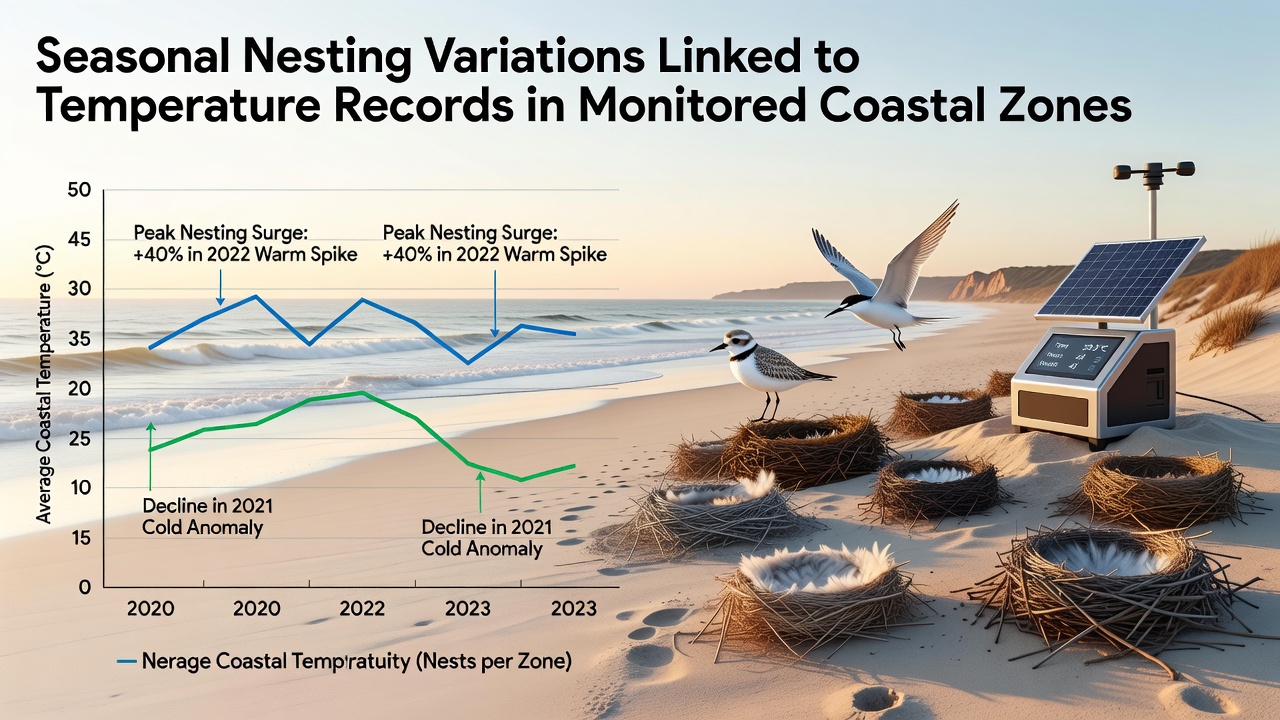
Monitored coastal zones worldwide show measurable changes in nesting timing for species such as sea turtles and shorebirds as temperature records continue to climb, according to long-term data sets compiled by government agencies and research institutions. These variations appear in earlier arrival dates at nesting beaches, compressed peak seasons, and shifts in hatchling emergence windows, all tied directly to recorded air and sea surface temperatures.
Programs tracking loggerhead and green turtle populations along the southeastern United States coastline document that nesting initiation now occurs an average of 6 to 12 days earlier than the 1990 baseline in areas where spring temperatures have risen by 1.2 degrees Celsius. Similar patterns emerge in monitored sites along Australia's eastern seaboard, where the Australian Institute of Marine Science reports comparable advances in peak nesting activity correlating with regional ocean warming trends.
Data Patterns Across Multiple Regions
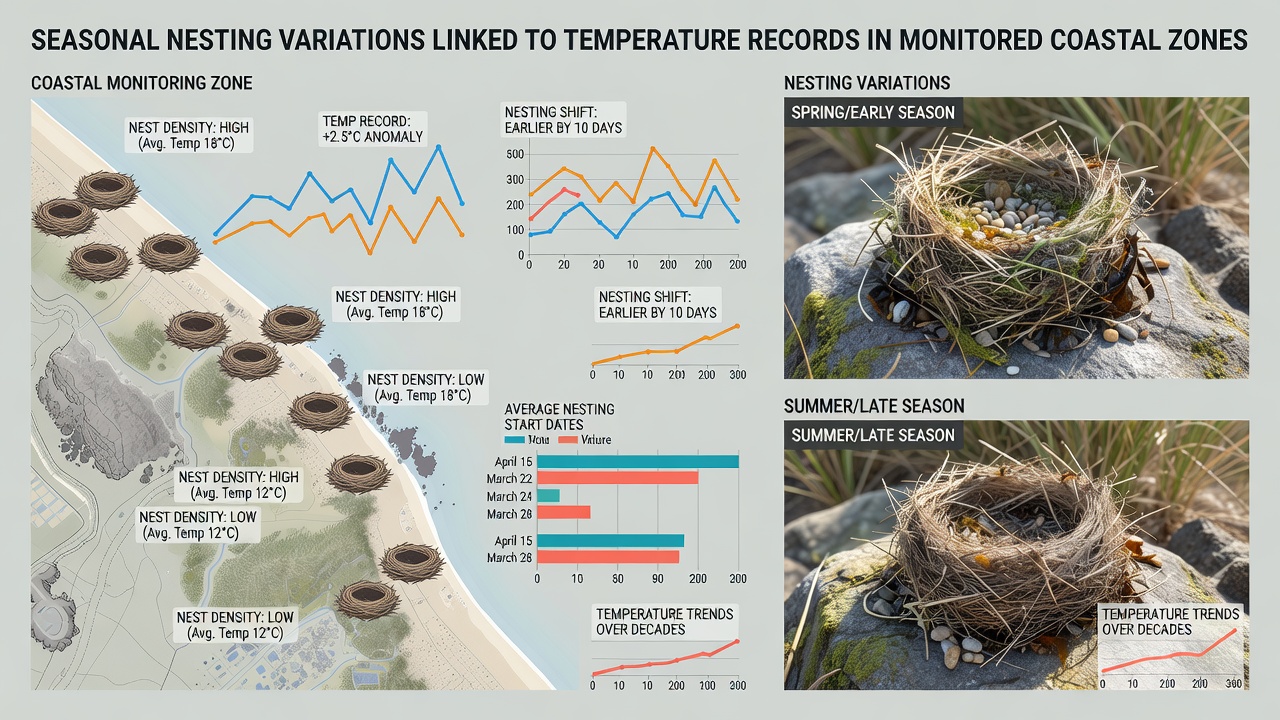
Continuous monitoring stations installed at key beaches record both ambient conditions and nesting activity, allowing direct comparison between temperature anomalies and behavioral responses. In the Gulf of Mexico, National Oceanic and Atmospheric Administration buoys logged the warmest March-April periods on record in 2025, and nesting surveys conducted through September 2026 confirm that female turtles began laying clutches several weeks ahead of historical averages. Hatchling emergence followed the same accelerated schedule, with many nests completing incubation 8 to 10 days sooner than expected under previous temperature norms.
European monitoring efforts along Mediterranean nesting beaches reveal parallel trends. The European Environment Agency aggregates data showing that loggerhead turtles in Greece and Turkey have adjusted nesting onset by roughly nine days over the past two decades, coinciding with documented increases in May sea surface temperatures. These shifts compress the overall season, concentrating more nests into a narrower window and raising questions about resource availability for both adults and emerging hatchlings.
Mechanisms Connecting Temperature to Nesting Behavior
Researchers link these timing changes to physiological cues that trigger migration and nesting. Warmer waters accelerate metabolic rates and gonadal development in adult females, prompting earlier departures from foraging grounds. Once on the beach, sand temperatures influence nest site selection, with females moving to slightly cooler microhabitats when surface readings exceed established thresholds. Temperature loggers placed at nest depth confirm that incubation periods shorten by approximately 1.5 days for every degree Celsius increase above the long-term mean.
Shorebird species monitored in the same zones exhibit comparable adjustments. Data from Canadian Wildlife Service programs on Arctic coastal plains indicate that some Arctic-breeding shorebirds now initiate nesting five to seven days earlier in response to earlier snowmelt and warmer spring temperatures, altering the overlap between chick-rearing periods and peak insect availability. These coordinated shifts across taxa suggest broader ecosystem responses to sustained temperature elevation rather than isolated species-specific adaptations.
Monitoring Methods and Record Keeping
Standardized protocols at established sites combine nightly beach patrols, satellite telemetry of tagged individuals, and automated temperature arrays that transmit real-time readings. Records maintained by the National Oceanic and Atmospheric Administration and partner institutions now span more than 30 years, providing the statistical power to distinguish seasonal variation from directional change. In September 2026, updated analyses incorporating the previous two seasons' data reinforced the correlation between cumulative degree-days above baseline and earlier nesting onset across multiple species and continents.
Cross-validation between satellite-derived sea surface temperatures and in-situ beach sensors strengthens confidence in the observed patterns. Discrepancies between offshore and nearshore readings remain within acceptable margins, allowing researchers to extrapolate findings to less intensively monitored coastlines. The resulting datasets feed into regional climate models that project continued advancement of nesting seasons under moderate warming scenarios.
Conclusion
Long-term records from coordinated coastal monitoring networks demonstrate consistent links between elevated temperature profiles and altered nesting phenology for marine and coastal species. These documented shifts, observed across geographically dispersed sites through September 2026, follow directly from measured environmental conditions rather than from anecdotal reports. Continued data collection at existing stations will clarify whether current trends stabilize or accelerate in coming seasons.